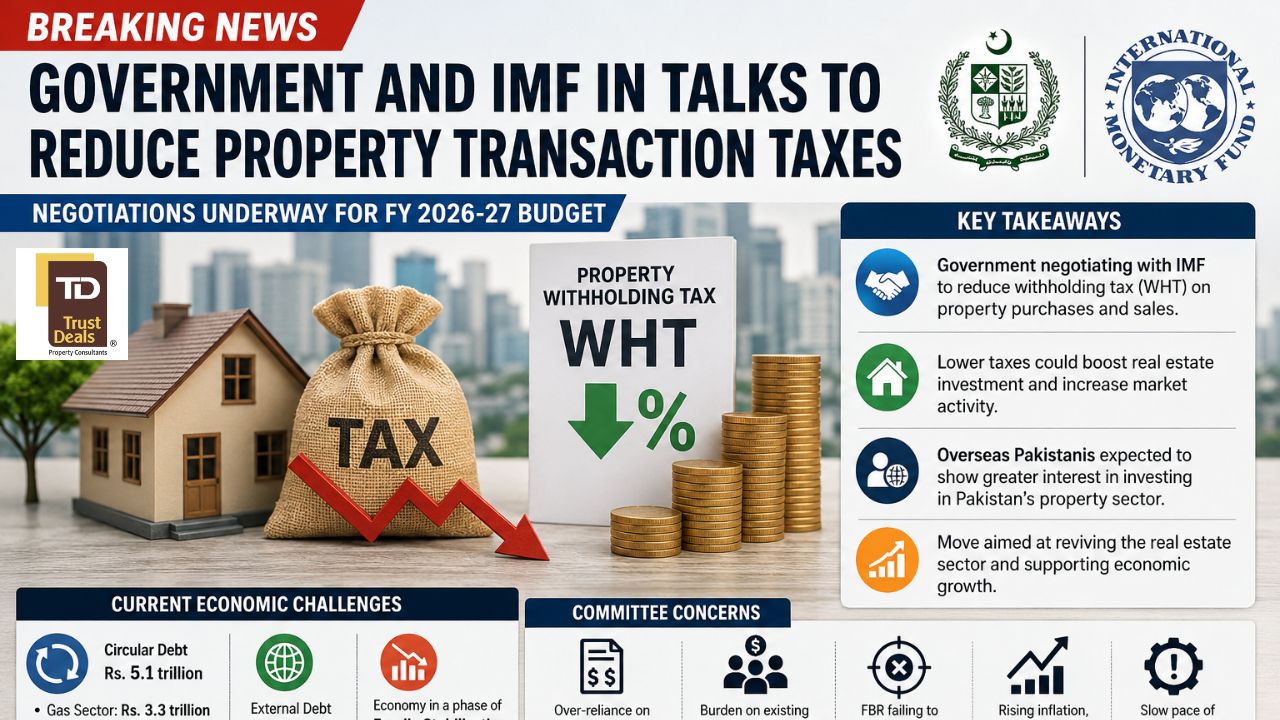
Islamabad: The federal administration has started talks with the International Monetary Fund (IMF) to lower the Withholding Tax (WHT) levied on property transactions in the next budget year, 2026–27. During a conference of the National Assembly Standing Committee on Finance and Revenue, Federal Board of Revenue (FBR) officials revealed the development.
Chaired by Syed Naveed Qamar at Parliament House in Islamabad, the committee meeting addressed the real estate industry, economic circumstances, budget plan, and Pakistan’s IMF program.
Government looking for relief for the Real Estate Sector
FBR authorities told the panel that the government is trying to persuade the IMF to reduce the withholding tax rates under Sections 236C and 236K of the Income Tax Ordinance, 2001, which regulate taxes on property transactions.
Officials say:
- The government wants to help the real estate sector.
- Talks with the IMF have reached a pivotal and delicate stage.
- Authorities believe that tax increases have negatively affected the real estate industry and reduced market activity.

Property Valuation Rates Already Cut
To help transactions and stimulate investment in the real estate sector, FBR officials also stressed that property valuation rates in some cities have already been lowered.
Overseas Pakistanis Could Expand Their Real Estate Holdings
Following recent events in the Gulf area and Middle East more generally, the committee considered whether overseas Pakistanis may move money and property to Pakistan.
Committee members observed:
- Lower real estate taxes would entice more foreign Pakistani visitors.
- The real estate market can benefit from new money.
- The economy might get a big lift.
Pakistan’s Economy Still in a Condition of Fragile Stabilization
In a briefing to the committee, economic expert Ali Salman of PRIME Institute noted Pakistan’s circular debt in the gas and power sectors has grown to Rs 5.1 trillion.
Circular debt breakdown:
- Debt in the gas industry is Rs 3.3 trillion.
- Debt of Rs 1.8 trillion in the energy sector
He further said Pakistan’s foreign debt is around $137.56 billion.
Although he noted indications of economic recovery, he cautioned that Pakistan is still in a period of “fragile stabilization” with many economic hazards still existing.
Important Issues Raised by the Standing Committee
Chairman Syed Naveed Qamar raised significant worries on many fronts, among them:
- Ongoing dependence on petroleum levy collections and indirect taxes.
- Raising the tax load on current taxpayers rather than extending the tax base.
- Repeated failure of FBR to meet tax collection goals.
- Rising poverty, joblessness, and inflation.
- Slow speed of changes in state-owned businesses.
Long-term economic stability depends, he stressed, on an increase in the tax base achieved by means of sustainable and fair changes.
Concerns About Budget Strategy Paper Delay
The Ministry of Finance was also criticized by the committee for neglecting to provide the Budget Strategy Paper on time.
The chairman said:
- Under the Public Finance Management Act, 2019, timely release of the paper is a legal need.
- Delays compromise openness in the budget process and parliamentary monitoring.
Good View for the Real Estate Industry
Should the government get IMF approval for tax cuts, the following advantages could arise:
- Less levies on property transactions and sales
- Lower transaction fees for vendors and customers
- More regional and international investment
- More involvement from Pakistanis living abroad
- More activity in the real estate market
Professionals think such a step might greatly stimulate Pakistan’s real estate market, which in recent years has suffered greatly from high taxes and more general economic pressures.